
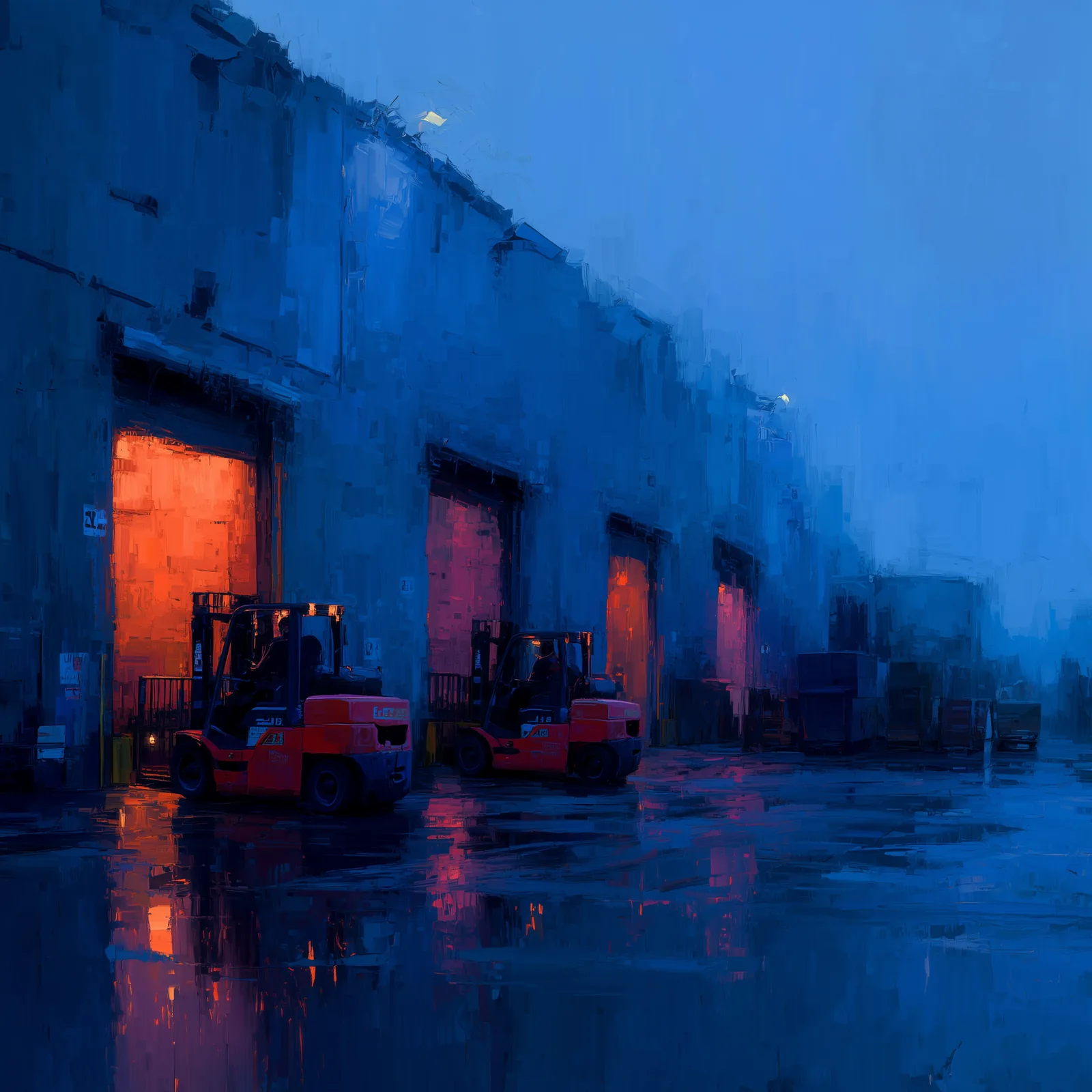




America has decided to reindustrialize. New factories, semiconductor fabs, battery plants, energy projects and defense capacity are going into the ground across the country, backed by hundreds of billions of dollars in public and private investment.
I spent the first part of my career building a manufacturer, so I am glad to see it. I also know what those new plants will run into on their first day of operation.
New buildings, old coordination
A new plant arrives with modern machines and modern software. Then it plugs into the same coordination model the rest of industry has used for decades. Suppliers confirm by email. Carriers receive load tenders as EDI messages from systems built in the 1980s. Bills of lading and rate confirmations move as PDFs. Inventory lives in one system and the production schedule in another, and partners share what they must, late and by hand.
The results are familiar. Buffer inventory to cover uncertainty. Lines waiting on parts that exist somewhere else. Trucks leaving the dock at a third to half of their capacity, as they do across American freight, with one mile in six driven empty.1 People spending their days moving information between systems that cannot see each other.
Building new plants on that foundation means pouring new concrete onto an old coordination model, and inheriting its costs from the first shipment.
The machines are arriving faster than the market can absorb them
The more important shift is happening on the machine side.
Driverless trucks began hauling commercial freight between Dallas and Houston in May 2025.2 Humanoid robot makers are building factories sized for mass production. Robot makers, autonomous trucking companies and factory automation vendors are moving at a pace the industrial economy has not seen before.
These machines are capable, and they will need work. A driverless truck needs to know what to carry, where to go and what the trip is worth. A fleet of humanoid robots needs orders, inventory and schedules. A highly automated factory needs to know what to build before anyone asks.
The market they have to get that work from was not built for them. Much of American freight is still tendered through EDI over value-added networks, often generated by mainframe and AS400 systems. Purchase orders arrive as PDFs. Status updates arrive by email. Capacity is negotiated by phone. A driverless truck cannot read an X12 204 sitting in a VAN mailbox. A robot cannot reply to a rate confirmation attached to an email.
The companies best positioned for this shift are the ones that own the whole stack. When one company builds the robots, the vehicles and the factories they work in, on its own systems, its machines can work together because it controls every system they touch.
Almost no one else is in that position. Without a shared translation layer, autonomous machines will be limited to the few customers who can rebuild their operations around them, and the rest of the industrial economy will keep running on people relaying messages. That gap is one of the biggest risks to reindustrialization, and one of the least discussed.
IOI is built to close it. It makes the kind of integrated coordination only the largest vertically integrated operators have today open and easy to set up for every manufacturer, carrier and distributor, on top of the systems they already run.
Legibility is the advantage
The countries that lead this century will all have capable machines. What will separate them is whether their physical economies are legible enough for those machines to coordinate with everything else.
Some countries will get there from the top down. China, with heavy government backing, pushed freight-matching platforms onto millions of drivers' phones to drive down empty running, and its logistics costs fell from 18% of GDP in 2012 to 14.4% in 2023.3 America's better path is a market: a neutral layer every company can plug into, with full control over what it shares. America also starts with an advantage it rarely gets credit for. Thanks to the ELD rule, nearly every truck in the country already reports where it is.
What changes when the layer exists
- Legacy partnersEDI, mainframes, PDFs and spreadsheets, as they run today
- Driverless trucksClaim loads tendered from any system
- RobotsRead orders, inventory and schedules
- Automated linesAccept requests to produce
- AgentsPlan inside the limits you set
Oway.
IOI is built to be that layer. Each company runs its own node, connected to the systems it already has, legacy and autonomous alike. The node keeps an IOI data lake built on an open-source schema, and that schema covers actions as well as state: read, write, produce, quote, book, track, tender and capacity, among others.
Once a new plant is on IOI, it can see what its suppliers can deliver and when, which carriers have open space heading its way and where its inputs and outputs are at any moment. Its own agents can plan production against live conditions inside limits the plant sets. Juno can price, schedule and route its freight in seconds.
The same holds for the machines. A driverless truck on IOI can claim a load that was tendered from an AS400, because the node has already translated the tender into the open schema. A robot fleet can read the orders and inventory that live in an ERP. An automated line can accept a request to produce from a customer's planning system. The legacy market keeps running as it does today, and the autonomous market gains a way to work with it immediately.
What we are building
Oway started with the empty space in trucks because it was the clearest place to prove the idea, down to the pallet. Today more than 10,000 vehicles are on our network, shippers move freight at up to 50% below market and carriers earn more on lanes they already drive.
IOI extends that approach to production, warehousing, robotics, energy and every operation that makes and moves things. Juno brings industrial AI that acts inside clear permissions. Oway OS is where the work runs.
This is the last note in our series on indexing the physical economy, and the work is just beginning. The challenge of our generation is to make the physical world legible, coordinated and trustworthy enough for intelligence to act on. It is very winnable, and we would love to build it with you. Join the team or talk to us about your operation.
-
American Transportation Research Institute (2025), An Analysis of the Operational Costs of Trucking, for 16.7% empty miles in 2024; American Trucking Associations, Trucking Trends, for average Class 8 payloads of about 29,000 lbs against rated capacities of 60,000 to 90,000 lbs. See The Half-Empty Truck. ↩
-
Aurora Innovation (May 1, 2025). "Aurora Begins Commercial Driverless Trucking in Texas." Business Wire. ↩
-
People's Daily (February 2025). "Reduced logistics costs help release China's economic vitality." See also Xu, X. et al. (2026), Nature Communications 17, 4714. ↩